
For roles where trust, integrity and public responsibility matter, a focused polygraph test can help examine specific employment-screening concerns before a sensitive appointment.
Lie Detectors UK provides private, examiner-led polygraph testing for police, law-enforcement, security and other high-trust employment situations.

Police, law-enforcement, security and safeguarding-related roles may involve public trust, restricted access, sensitive information or contact with vulnerable people.
Polygraph screening may be considered where an employer has a specific, role-relevant concern that needs to be examined before an appointment, promotion or employment decision.
This service is focused on private employment and sensitive-role screening. It is not an offender-monitoring service, police interrogation procedure or substitute for a criminal investigation.
For employment screening, the test should focus on clear factual areas such as declared work history, application statements, conflicts of interest, misuse of sensitive information, undeclared conduct or another specific integrity concern.
A police or law-enforcement employment polygraph test should support a wider recruitment or vetting process. It does not replace background checks, DBS checks where required, references, official vetting, HR procedures, legal advice or the employer’s final decision.
The examination should address specific questions relevant to the role rather than make a broad judgement about whether an applicant is trustworthy. Depending on the circumstances, suitable questions may concern:
Before the appointment, the employer or candidate explains the specific employment-screening concern. The polygraph examiner reviews the circumstances to determine whether the issue is suitable for testing and whether it can be reduced to clear, role-relevant questions.
At the appointment, the examiner conducts a pre-test interview. The testing procedure is explained and every relevant question is reviewed with the candidate before the actual test begins. The person being tested must understand the process and agree to participate.
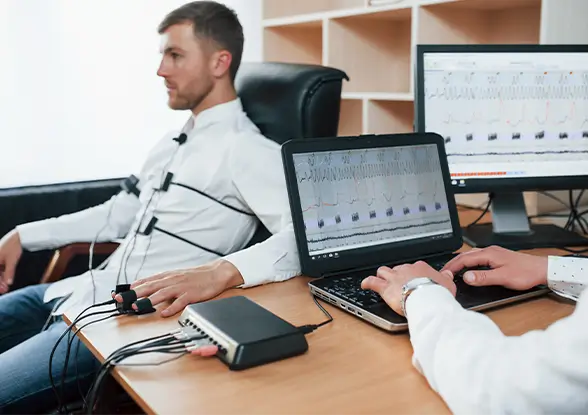
During the polygraph examination, professional equipment records physiological responses while the candidate answers the agreed questions. The equipment records changes including breathing patterns, cardiovascular activity, blood pressure and skin conductivity. The polygraph does not directly detect deception. These physiological responses form part of the information the examiner evaluates across the complete examination.
After testing, the examiner reviews and scores the recorded charts using the appropriate procedure before explaining the polygraph result. The result should not be based on one answer or one physiological reaction. An inconclusive result is also possible. Where the examination forms part of pre-employment screening, the polygraph results should be handled confidentially and considered alongside the employer's wider background investigation, vetting procedures and other information.
A police or law-enforcement employment polygraph test depends on carefully prepared relevant questions. This keeps the examination focused on factual employment-screening issues rather than broad judgements about the candidate’s personality or character.
The questions should be:
Accuracy
Clients often contact Lie Detectors UK during sensitive personal, relationship, or workplace situations. These reviews highlight the communication, professionalism, and care our clients experienced during the process.
For serious disputed matters where the focus is on the polygraph examination method, recorded physiological responses and professional interpretation.
For specific allegations involving missing property, stolen money, unauthorised transactions or a defined act of fraud.
For employment screening concerns that are not limited to a specific theft or fraud allegation.
For investigator-led enquiries or cases where a polygraph examination forms part of a wider private or corporate investigation.
For solicitor, court-related or legal-use questions where you need to understand how a private report may fit into a wider legal situation.
A police employment polygraph is a structured examination used to assess responses to specific factual questions relevant to employment screening.
Professional polygraph equipment records physiological responses while the candidate answers the agreed questions. The examiner then reviews the recorded data and reports the outcome.
Yes. The person taking the test must agree to participate before the polygraph examination can proceed.
The examiner explains the process and reviews the relevant questions before testing begins.
No. Polygraph screening should support a wider employment-screening process.
It does not replace background checks, DBS checks where required, references, official vetting, HR procedures, legal advice or the employer’s final decision.
A polygraph does not directly measure honesty or deception. It records physiological responses while the applicant answers structured questions.
The examiner evaluates those responses as part of the complete testing procedure. The findings should therefore be considered alongside other information obtained during the wider recruitment or vetting process.
Candidates commonly feel nervous before an examination.
Physiological responses can be influenced by factors other than deception, which is why the examiner does not determine the result from one physical reaction. The pre-test interview, agreed questions, recorded charts and complete examination are considered when evaluating the result.
Questions should be clear, factual and relevant to the employment concern.
They may relate to declared information, application statements, specific conduct, conflicts of interest or another role-relevant issue suitable for examination.
The written report should be handled confidentially and shared according to the arrangements agreed for the examination.
Where an employer is involved, the intended recipient and handling of the report should be established before testing.
Please allow around two hours for the appointment.
This includes the pre-test interview, question review, actual test, analysis and explanation of the reported outcome.
No specialist preparation is normally required because the examiner explains the process before testing.
The candidate should avoid alcohol and illegal drugs for at least 12 hours before the appointment and should arrive rested and ready to follow the examiner’s instructions.
If you need to examine a specific, role-relevant concern before a sensitive employment decision, contact Lie Detectors UK to discuss whether polygraph testing is suitable.